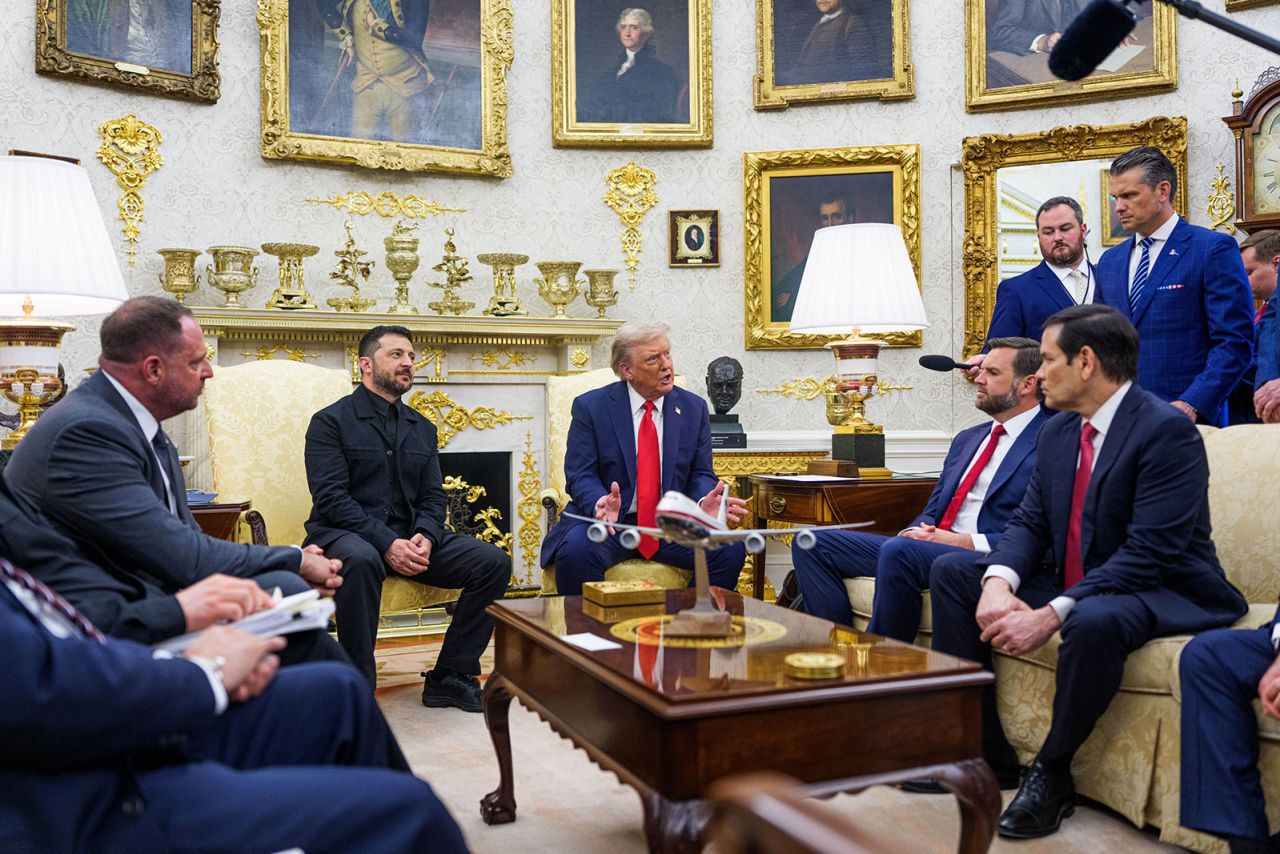
Just days after Donald Trump’s headline-making encounter with Vladimir Putin in Alaska, Volodymyr Zelenskyy arrived in Washington—where he was joined by key European leaders—for a round of talks at the White House. The back-to-back meetings indicated a new, high-stakes phase in the search for an end to the war in Ukraine, but they seemed to have delivered more spectacle than substance. Trump cast himself as the impatient dealmaker, eager to push Kyiv toward concessions; Putin continued to test Western resolve with maximalist demands; Zelenskyy insisted on binding security guarantees before even contemplating peace; and European leaders, wary of both Moscow’s aggression and Trump’s impulsiveness, left warning that half-baked compromises could jeopardise not just Ukraine’s sovereignty but Europe’s security for years to come.
Curiously, Trump presented himself as the “indispensable mediator,” declaring that the United States could provide security guarantees for Ukraine. For the first time, he even hinted that U.S. peacekeepers on the ground were not out of the question. Zelenskyy welcomed this, stressing that Ukraine’s survival depends on U.S. support. He revealed that the talks included proposals for a $90 billion package of weapons—aviation systems, anti-missile defences, and other advanced arms—along with a deal for the U.S. to purchase Ukrainian-made drones.
However, the discussions also exposed deep divides. Trump admitted that he now prefers a “land swap” arrangement—Ukraine giving up territory in exchange for guarantees—rather than the earlier idea of securing a ceasefire first. He argued that concessions are the fastest route to peace. For Trump, “there’s no deal until there’s a deal,” and speed matters more than principle. By contrast, Zelenskyy and European leaders insisted that a ceasefire must come first, otherwise Moscow would keep using offensives to shift the lines in its favour.
Trump claimed that Putin had agreed in principle to security guarantees for Ukraine. But this was quickly contradicted by Russia’s foreign ministry, which warned that NATO troops on Ukrainian soil would mean “uncontrollable escalation.” Once again, Trump’s announcements seemed designed more to showcase progress than to reflect genuine consensus.
Zelenskyy showed some willingness to meet Putin directly—something the Kremlin has consistently rejected. He said Ukraine “will never stop on the way to peace,” but warned that territorial concessions are not acceptable. Trump, however, openly suggested that current frontlines could serve as the basis for negotiations, a stance that leans toward Putin’s position.
The White House summit therefore highlighted the contradictions at the heart of Trump’s diplomacy: promises of guarantees and U.S. involvement, alongside a willingness to pressure Ukraine into concessions. For Zelenskyy, the priority remains clear—first a ceasefire, then negotiations, with sovereignty intact. For Putin, maximalist demands stand. And for Trump, the key is to cut a deal quickly, regardless of the details.
Timeline of the War
The Ukraine war had actually started much before 2022. Its history goes back to 2013–14, when demonstrations in Kyiv over President Yanukovych’s rejection of closer ties with the EU led to his removal. Russia annexed Crimea in March 2014, citing the protection of Russian speakers, and supported separatist “republics” in Donetsk and Luhansk, triggering the initial Donbas conflict.
By late 2021, U.S. intelligence tracked a massive Russian troop build-up, warning of an invasion. On 24 February 2022, amid all warnings and criticisms, Putin unleashed the full-scale assault. Russian forces struck Kyiv and other major cities, but by April they had withdrawn from the capital region after heavy losses. The atrocities in Bucha and elsewhere had shaken the world.
From mid-2022, the fighting shifted to the east and south. Russia captured Mariupol, seized large parts of Donetsk and Luhansk, and in September 2022, claimed to annex four regions: Donetsk, Luhansk, Kherson, and Zaporizhzhia. Ukraine mounted counteroffensives in Kharkiv and Kherson, regaining significant ground, but the front hardened into a stalemate by 2023.
Russia’s war has come at a staggering human cost. According to the UK Ministry of Defence, more than one million Russian soldiers have been killed or wounded since 2022. The U.S.-based CSIS estimates up to 250,000 Russian deaths and total casualties of 950,000. Ukraine’s losses are also severe: 60,000–100,000 killed and total casualties of around 400,000. Independent outlet Mediazona has verified 111,000 Russian deaths by name but believes the true figure is far higher. Civilian suffering is immense. Over 40,000 civilians have been killed or injured. 3.7 million people are internally displaced, while 6.9 million are refugees abroad. More than 12.7 million require humanitarian aid.
Economically, the war has devastated Ukraine, while sanctions have strained Russia but not broken its economy. Ukraine has received about $407 billion in aid, including $118 billion from the U.S.—$65 billion of which is military aid. Russia, meanwhile, has leaned on China, India, Iran, and North Korea to keep its economy afloat and its army supplied. Three years into the war, Russia occupies about 20% of Ukraine and has seized over 4,000 sq km since 2024. Despite massive losses, Moscow shows no sign of retreating. Ukraine, though determined, is stretched thin and reliant on outside aid.
Putin’s Demands, Zelenskyy’s Red Lines, and Trump’s Role
Putin’s position remains uncompromising. He insists on full control of the Donbas, and continues to demand recognition of Crimea, Zaporizhzhia, and Kherson as Russian territory. However, the Institute for the Study of War (ISW) argues Russia cannot conquer the rest of Donetsk by force—its advances have been painfully slow, with gains of only 11 km in 26 months around Chasiv Yar and no success in 18 months of assaults on Pokrovsk.
Zelenskyy has made his stance equally clear: no concessions of territory. For him, the Donbas is not only an industrial heartland but also a critical defensive line. Losing it would open Ukraine to further Russian advances toward Kharkiv, Poltava, and Dnipro. As he warns, giving up the Donbas would give Moscow “a springboard for a future offensive.”
Trump’s role is far more unpredictable. He openly entertains Putin’s proposals of a “land swap” and even echoes Moscow’s stance on Crimea. He has suggested Ukraine could “end the war almost immediately, if it wants to,” by conceding territory. At the same time, he courts Zelenskyy with promises of U.S. guarantees and weapons.
European leaders, by contrast, have stood firmly with Kyiv, making it clear that any show of weakness before Moscow would only pave the way for larger conflicts in the future. Leaders like Emmanuel Macron and Keir Starmer have cautioned that yielding to Putin’s designs today would legitimise aggression and invite further instability. Their stance highlights the dangers of Trump’s quick-fix diplomacy, which seeks a rapid agreement even at the cost of Ukraine’s sovereignty and Europe’s long-term security. The sharpness of the contrast between the main actors is striking. Putin continues to advance his maximalist demands, relying on war fatigue in the West to eventually break Ukraine’s resolve. Zelenskyy, in turn, refuses outright any territorial concessions, insisting that credible guarantees must precede negotiations if peace is to be meaningful. Trump, impatient and business-minded, is ready to pressure Ukraine into compromise for the optics of a “deal,” showing little concern for its consequences. Europe, meanwhile, remains supportive of Ukraine yet cautious, wary both of Putin’s expansionism and Trump’s unpredictability. Together, these positions reveal not only the interrupted nature of the diplomatic field but also the high stakes of a settlement that could either reinforce international norms or erode them beyond repair.
Geopolitics and the Political Economy of War
Beyond battlefield lines, this war is also about resources and geopolitics. Analysts argue that Russia’s invasion reflects not just fear of NATO expansion but also a struggle for control of Ukraine’s vast natural wealth. Ukraine possesses 20,000 mineral deposits, including some of the largest reserves of titanium, lithium, graphite, gallium, neon gas, and uranium in Europe. These are crucial for global supply chains in energy, defence, and digital technologies. Before the invasion, Ukraine supplied 90% of U.S. semiconductor-grade neon and ranked among the top holders of lithium and rare earths.
By occupying parts of Donetsk, Luhansk, Kherson, and Zaporizhzhia, Russia has seized control of $12.5 trillion worth of resources, including over half of Ukraine’s coal and much of its oil and gas fields. Russia also controls 80% of Ukraine’s offshore gas in the Black Sea. For Putin, these assets are both economic lifelines and levers of power over Europe. The Donbas alone is an industrial powerhouse, historically central to Ukraine’s steel and coal production. Losing it would cripple Ukraine’s economy, making the country more dependent on Western aid. For Moscow, it would strengthen both military positions and long-term economic control. Trump has not hidden his corporate instincts. He suggested that U.S. aid to Ukraine—some $500 billion—should be tied to access to its mineral wealth. Zelenskyy once rejected this idea, but later yielded to Trump which revealed how resource politics now shapes diplomacy. Europe, too, sees Ukraine as central to its Green Deal, since Ukrainian lithium and rare earths could reduce dependence on China.
Thus, the Ukraine war is not only about borders and sovereignty but also about who will control the resource base of Europe’s future economy. This makes concessions all the more dangerous: if Ukraine loses its mineral heartlands, it will lose its independence in more than a territorial sense.
What Lies Ahead?
The choices before the world are plain. Should the international community concede to Russia’s expansionist demands, legitimising annexation and rewarding aggression? Or should it reaffirm that borders cannot be changed by force, even at the cost of prolonging war?
Trump’s pursuit of a “deal” risks normalising the logic of conquest. If Ukraine is pressured into ceding Donbas or other regions, Moscow will see aggression as a successful tool. Other authoritarian powers may draw the same lesson. International law would be left meaningless, and institutions like the UN reduced to bystanders.
At the same time, NATO expansion remains a divisive issue. Russia has framed it as an existential threat, while for Eastern Europe it is a lifeline. If Ukraine is forced out of NATO or neutralised, Russia will gain a veto over Europe’s security order. However, admitting Ukraine into NATO now risks escalation with a nuclear-armed Russia. The war has already shown the high cost of appeasement. Putin’s earlier gains in Crimea and Donbas only bolstered him to launch the 2022 invasion. Concessions now may buy short-term tranquil but guarantee long-term instability.
In the end, the outcome may rest on whether Europe and the United States can stay united. Zelenskyy has warned that without security guarantees and clear commitments. Ukraine’s future will remain under constant threat. For him, peace cannot be built on surrender. For Trump, however, peace is a matter of signatures and optics. For Putin, it is about imperial survival and resources. If international law is abandoned for quick deals between the powerful, conquest will regain its legitimacy as an instrument of statecraft. The Ukraine war is not merely a struggle over borders. It is a battle over whether rules still govern the international order, or whether raw force decides.
Published in Countercurrents.org