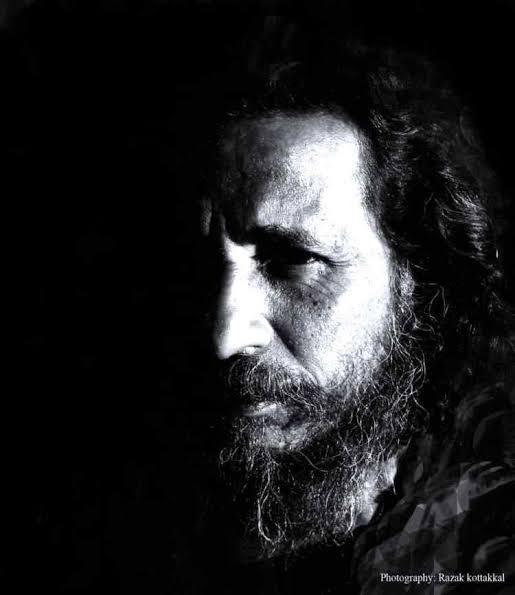
Photo by Razak Kottakkal
“The anger and the creativity are so closely intertwined with me, and there’s plenty of anger left,” Ingmar Bergman once said. In Kerala’s film world, if there was anyone in whom anger and creativity fused into a restless force, it was John Abraham — a master of the arts in the truest sense. His 88th birth anniversary falls on 11 August 2025, almost unnoticed, as if his name has slipped from public memory.
His death anniversary too, on 31 May, passed in silence. At the same time, Kerala’s media — print, electronic, and social — were busy feasting on sensational issues. The contrast is telling: a genuine pioneer of an alternative cinema culture ignored, while the industry’s own rot is paraded as entertainment.
The irony deepens when one recalls John’s final film, Amma Ariyan (1986), which today reads as a mirror to the moral crisis gripping Kerala’s film world and its institutions, including the Association of Malayalam Movie Artists (AMMA). For John, “Amma” was the figure of sacrifice — the one who truly understood her children, yet was rarely consulted or trusted by them. The film’s backdrop lay in the despair of young Naxalites John had known in the mid-1970s, whose suicides spoke of bitter disillusionment with the revolutionary dream they had embraced with passion and romantic faith.
But Amma Ariyan was as much about its making as its message. John was already a fierce critic of financiers — many from outside Kerala — who treated cinema purely as a profit machine. He saw that as long as the industry remained in this stranglehold, true creative freedom was impossible. The answer, he believed, lay in building alternative paths and audiences. That conviction gave birth to the Odessa Collective in the mid-1980s — a radical experiment in people-led production, distribution, and screening. With Amma Ariyan as its flagship, Odessa sought to democratise cinema, placing those at the bottom at the heart of the process. It was short-lived, but it cracked open the door to an alternative film culture untainted by the cobwebs of capital and control.
Trained at the Pune Film Institute under masters like Ritwik Ghatak, John made only four feature films — Vidyarthikale Ithile Ithile (1972), Agraharathil Kazhuthai (1977), Cheriachante Krurakrithyangal (1979), and Amma Ariyan (1986) — alongside short films and documentaries. Agraharathil Kazhuthai, a Tamil feature, won the National Award for Best Film in its category in 1977; Cheriachante Krurakrithyangal received the Kerala State Jury Award in 1979; Amma Ariyan won the National Jury Award in 1987. Yet, awards never meant more to him than the acceptance of the people.
He despised pretension in art. He refused to speak to his village folk in a language alien to them. His philosophy was deceptively simple but rooted in political and intellectual depth. Cinema, for him, was a critical and exploratory act, not a mass distraction. A good film should breach the limits of entertainment, carry a purpose, and awaken thought. He shared Brecht’s belief in an “epic theatre” — telling stories plainly, so audiences could think critically about what they saw.
John lived like a nomad, drifting from place to place, a permanent migrant in the republic of argument. He thrived in conversation — with villagers, students, scholars, and fellow filmmakers — free of intellectual posturing. As a storyteller, he used wit and humour to pull audiences in, often making them think in ways they had not expected. In doing so, he was constantly rewriting his own life script, deconstructing himself, experimenting with change.
Kerala’s film world since the 1980s has lost that spirit — the rigorous, sceptical, passionate engagement with events as they unfold. John Abraham belonged to a rare breed for whom cinema was not just an art, but a public act of resistance, thought, and love.
An early draft was published in Countercurrents in 2017