
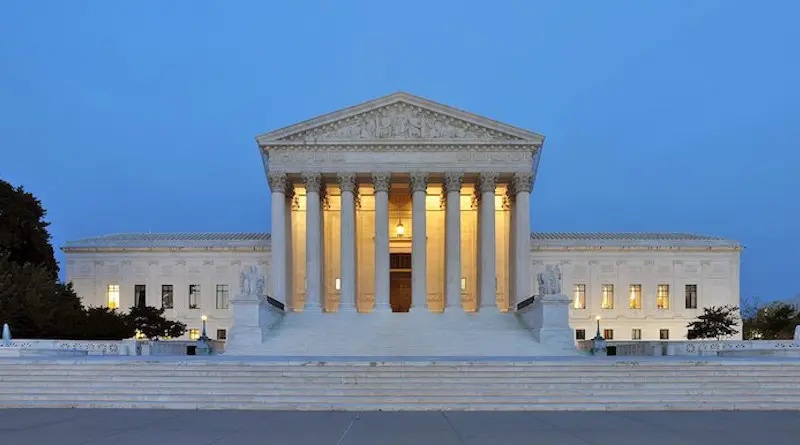
First published in Eurasia Review, 22 February 2025
The ruling of the U.S. Supreme Court striking down Donald Trump’s emergency tariff regime has come as one of the most important institutional glints in contemporary American politics. For years, Trump treated trade policy as a personal instrument of power, deploying tariffs with sweeping ambition and minimal consultation with Congress. The Court’s judgment has now warned the presidency that economic authority flows from the Constitution and the White House cannot flout established procedures and practices.
The dispute arose from Trump’s use of emergency powers to impose wide-ranging tariffs on imports. The administration justified the move as necessary to correct global imbalances, revive domestic industry, and reduce dependence on foreign supply chains. Its argument rested on the claim that trade deficits and declining manufacturing represented threats to national economic security. The White House framed tariffs as a structural tool to change global production and restore American strength.
But the Supreme Court rejected this approach. The justices held that emergency economic powers do not authorize sweeping tariff programmes and reaffirmed that taxation authority belongs to Congress. The ruling, therefore, restores a constitutional boundary that had weakened during Trump’s presidency. It sends a message that even in matters of foreign economic policy, presidential power has limits.
A constitutional turning point
The decision carries significance because it addresses a major institutional problem. The U.S. Constitution assigns Congress the authority to regulate commerce and impose tariffs, while the President negotiates and implements policy. For decades, trade governance relied on this collective arrangement. Recent administrations have moved power toward the executive branch, often concluding agreements or imposing measures without strong congressional involvement. The Congressional Research Service notes that this growing executive flexibility has generated debate over whether Congress’s traditional role in trade policymaking is being eroded.
Trump pushed this imbalance further than any recent president. By declaring trade deficits an emergency, he attempted to transform a structural economic issue into a justification for unilateral action. Legal scholars had long warned that emergency statutes were designed for targeted sanctions, not broad economic policymaking. Expanding them into a permanent trade instrument would undermine congressional authority and normalizing executive control over taxation. The Court’s ruling, therefore, does more than cancel a policy. It restores a constitutional principle. Tariffs are taxes, and taxes require legislative authority. This reasoning reflects the Court’s reliance on the “major questions doctrine,” which holds that sweeping economic decisions require explicit congressional approval.
Trump’s trade adventure and its institutional costs
Trump’s tariff policy has been viewed as a larger transformation in American economic thinking. Earlier administrations treated trade as part of a multilateral system designed to stabilize relations and expand markets. Trump changed it as a strategic weapon. Tariffs became bargaining tools used to pressure allies, extract concessions, and restructure production chains. Trade policy moved from soft diplomacy to open confrontation.
This change had consequences for American institutions. It weakened congressional oversight, blurred the legal basis of trade agreements, and created uncertainty for businesses and allies. Even before the Court’s ruling, many analysts noted that the legal foundation of several tariff-driven deals remained delicate. If the authority behind those measures collapses, the agreements negotiated under pressure may lose relevance. Trump’s approach also strained the legitimacy of the rule-based trade system that the United States helped build after the Second World War. Instead of acting as a guarantor of stability, Washington increasingly appeared unpredictable. Partners faced sudden duties, unstable legal arguments, and threats tied to political demands.
The Court’s intervention now opens the possibility of restoring institutional balance. It indicates that trade policy must operate through law, procedure, and legislative participation rather than executive impulse.
Implications for global trade relations
The ruling also matters beyond the United States. American trade policy affects economic expectations across the world. When Washington adopts unilateral tariffs, partners respond with defensive measures, new alliances, or legal challenges. For the European Union, Canada, and other allies, the judgment offers hope for greater predictability. Officials have repeatedly stressed that stable trade relations require clear legal foundations. The decision may encourage negotiations based on rules rather than pressure.
For countries like India, the implications are equally significant. India’s trade engagement with the United States increasingly involves technology, supply chains, and strategic cooperation. These partnerships require long-term certainty. If tariffs can change suddenly through executive action, businesses hesitate to invest. The Court’s ruling reduces that uncertainty by affirming that large tariff shifts must pass through Congress.
Still, the judgment does not eliminate risk. Trump has already indicated his willingness to pursue tariffs under alternative statutes such as the Trade Act of 1974. This means the underlying philosophy of aggressive trade leverage may continue. The legal route has narrowed, but the strategic approach remains alive.
Rebuilding credibility at home
Perhaps the most important consequence of the ruling lies within American democracy itself. Trump’s presidency often relied on personal authority rather than institutional consensus. Courts, Congress, and regulatory agencies faced sustained pressure. In this environment, many observers feared that constitutional checks were weakening. The tariff case shows that institutional self-correction remains possible. Even a Court that often supported Trump’s agenda chose to draw a line. The coalition behind the judgment included conservative justices alongside the liberal bloc, reflecting a concern for constitutional order. Chief Justice John Roberts joined two conservative justices appointed by Trump along with the liberal bloc, suggesting that Trump’s disregard for constitutional limits has begun to unsettle even parts of the conservative majority. This certainly can help restore public confidence in the separation of powers. When courts reaffirm constitutional limits, they strengthen democratic norms. When Congress regains its legislative role, policymaking becomes more accountable.
What Congress must do next
The ruling also places responsibility squarely on Congress. For decades, lawmakers delegated broad trade powers to the executive branch. This delegation allowed presidents to negotiate agreements and respond quickly to global challenges. Over time, it also reduced congressional engagement in trade debates.
If Congress wants to reclaim its authority, it must act. Several reforms could help. Lawmakers could clarify the limits of emergency powers, require periodic approval of tariff measures, and ensure that major trade actions receive legislative scrutiny. Such steps would rebuild institutional balance while preserving flexibility in genuine crises.
The Congressional Research Service emphasizes that trade policy today involves industrial strategy, technological competition, and geopolitical rivalry. Decisions in this arena impact employment, security, and global alliances. For that reason alone, they should reflect collective deliberation rather than unilateral action.
Lessons for Trump and the presidency
The Court’s decision offers a lesson for Trump himself. Leadership in a constitutional system requires respect for institutional boundaries. Economic power cannot be exercised indefinitely through emergency declarations. The ruling also reveals that even strong political mandates cannot override constitutional design. A president may seek to change trade relations, but such change must occur through lawmaking and negotiation. Attempts to bypass that process invite judicial correction.
If Trump wishes to pursue a nationalist trade strategy, he now faces a clear path. Persuade Congress, build coalitions, and craft legislation. That route may be slower, but it offers legitimacy and durability. A major question concerns the future of American liberal democracy. Years of polarized politics and institutional strain have shaken confidence in the system. The tariff ruling provides a rare opportunity of reassurance. It shows that constitutional checks still function, and that executive overreach can meet resistance.
This ruling has come at a politically sensitive time, with elections approaching and public trust in institutions under pressure. If Congress responds responsibly and courts continue to enforce limits, the United States may recover some of its credibility at home and abroad. A more balanced trade policy could follow – one that takes into consideration strategic interests with legal stability, one that treats partners as collaborators rather than targets and one that considers economic power with democratic procedure. The Supreme Court’s decision against Trump’s emergency tariffs amounts to restoring Congress’s authority over taxation and reaffirming judicial oversight, and the ruling strengthens the foundations of democratic policymaking. Tariffs may return under other statutes. Trade conflicts may continue. But the institutional message is clear.
If Congress rises to this moment, and if the presidency accepts constitutional limits, American trade policy could regain both legitimacy and predictability. That would benefit citizens, businesses, and partners across the world.