First appeared in Eurasia Review
Iran is passing through one of the most dangerous moments since the revolution in the late 1970s. What began as economic distress has turned into nationwide unrest, and what started as internal repression has now transformed into open international confrontation. Streets are tense, communications are cut, security forces are deployed at scale, and families wait without news of those arrested or killed. At the same time, the language of war has returned to international headlines, with the United States openly threatening action and regional militaries shifting into precautionary positions.
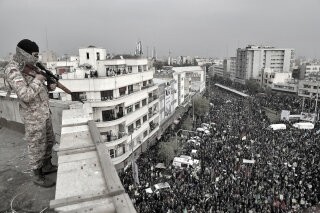
This goes beyond a routine protest cycle, or the familiar standoff between Tehran and Washington. Iran’s currency has collapsed, inflation has stripped wages of meaning, and the middle class that once absorbed pressure has largely disappeared. The state has responded with force, sealing the country behind digital blackouts and mass arrests. Every protester shot in the street, and every rumour of foreign involvement, worsens fear on both sides and narrows the space for retreat.
The crisis unfolds in a region already affected by war. Israel’s confrontation with Iran and its allies, attacks on shipping lanes, and the steady decline of diplomatic restraint have created a setting where miscalculation can spread quickly. When the US president says that “very strong action” is possible, the threat is not abstract. Military planning, sanctions, and economic coercion are already in place. Iran’s leaders read these messages as preparation for regime change, while many Iranians fear that their struggle for dignity could be turned into a pretext for another war.
Of course, the immediate trigger has been economic shock. The rial’s fall to around 1.4 million per US dollar and inflation above 40 percent have made daily life unstable, especially for wage earners and small traders. When the currency drops fast, prices change by the hour. Shops close because sellers cannot replace stock. That is why the first visible spark came from Tehran’s Grand Bazaar, where merchants shut stores in protest and fear. From there, demonstrations spread beyond the capital and began to sound like a challenge to the political system itself.
This economic crisis did not come from one cause. Sanctions have restricted Iran’s trade and finance channels for years, while internal policy failures have added their own burden. Many analysts point out a social effect that is easy to miss. long sanctions pressure often hurts the middle class that usually supports reform and stability. That can leave a sharper split between a protected elite and a stressed majority. In Iran, the state-linked economy has also created space for well-connected actors to profit from shortages and smuggling. Public anger then becomes anger at corruption and privilege, not only at prices.
The crisis is also political, because the state’s response has relied on force and silence. Iran has imposed a near-total internet shutdown, which monitoring groups and technical platforms have tracked in real time. A blackout blocks coordination among protesters. It also blocks evidence of killings and arrests. It can even disrupt banking and essential services. Reports describe a shutdown that has lasted more than five days at points, with only partial restoration.
The human toll is already severe, though exact numbers remain contested because of the blackout and fear inside hospitals. A major rights monitor, HRANA, has reported deaths in the thousands, and large arrest numbers. Iranian authorities have issued their own lower or different figures and often blame “terrorists” and foreign hands. International outlets also describe fast trials, coerced confessions on state media, and threats of executions as tools to crush momentum.
The Iranian state under clerical rule
Iran’s political order is built around velayat-e faqih, where the Supreme Leader and unelected bodies hold decisive power over elected institutions. Iran has elections, a parliament, and a presidency. However, core veto power sits with institutions such as the Guardian Council and security organs that answer upward to the Supreme Leader. Many studies describe this as a hybrid system that keeps republican form while limiting real accountability. The result is a state that can manage factions, but resists structural reform.
This structure has determined how the regime treats popular movements. Over many protest waves—2009, 2017–18, 2019, 2022, and now—the state has relied on a pattern – blame foreign enemies, cut communications, deploy police and paramilitary forces, arrest organisers, and use fear to end street mobilisation. A UN mechanism has recently called for restoration of internet access and has reported killings, including children, in the early phase of these protests as well.
Women’s movements have faced a distinct form of repression because control of dress and public behaviour has been treated as a pillar of regime authority. The Woman, Life, Freedom uprising after the death of Mahsa Amini in 2022 became a turning point in how many Iranians spoke about the system itself. Later analyses argue that repeated uprisings have created a major legitimacy crisis, so the state leans more on coercion and on the security role of the Revolutionary Guards.
Workers’ organising has also faced pressure. Strikes and labour protests appear often in Iran’s industrial sectors, but independent unions face arrests and legal harassment. Economic hardship then becomes politically explosive because people feel trapped between inflation and repression. Some research outlines the state’s behaviour as regime survival logic. When the system feels threatened, repression increases, and foreign policy becomes more securitised.
Minorities, including Kurds, have long reported discrimination and harsh security responses in their regions. In many protest cycles, Kurdish areas have seen heavy deployments and high casualties. The present blackout makes province-level verification difficult, but the pattern is extensively documented by rights reporting over time.
A second pillar of the regime is its regional network of armed partners. Iran’s Revolutionary Guards and the Quds Force have supported groups that include Hezbollah in Lebanon, armed factions aligned with Hamas, and the Houthis in Yemen, among others. This network serves deterrence and influence. It also creates constant friction with Israel, Gulf states, and the United States. It invites sanctions and retaliatory strikes, which then tighten the economic noose at home.
Many Iranians see a gap between Islamic ideals of justice and the lived reality of privilege, coercion, and corruption. That gap has become political fuel. It is one reason the state faces protest even after decades of policing.
External perceptions and interests
Outside powers are reading Iran’s turmoil through interests, risks, and history. For the United States under President Donald Trump, Iran is being seen as both a security threat and an opening for pressure. Trump has publicly urged protesters to continue and has said “help is on the way,” while also reminding that military options are under review. This messaging matters because it changes how Tehran interprets unrest. The regime starts to treat protest as a national security battle, then it justifies more violence.
Trump has also used economic coercion in a wide way. He announced a 25 percent tariff threat against countries doing business with Iran. That is designed to tighten Iran’s isolation by raising the cost of trade for third parties. It also pressures countries that import Iranian oil or maintain channels with Tehran.
Regional powers fear spillover. Gulf states host US bases and depend on stable shipping lanes and energy prices. If a US strike hits Iran, Iran can retaliate across the region. Reports already describe precautionary steps around bases, including at Al Udeid in Qatar, and warnings that escalation could hit oil markets. That fear pushes regional governments toward public calls for restraint, even when they dislike Iran’s policies.
Russia and China oppose regime-change language and oppose US force, for reasons that involve principle and strategy. They distrust Western intervention claims. They also see Iran as a partner against US influence and as part of energy and security calculations. Russian voices warn that a US attack would destabilise the region and disrupt oil markets. China calls for non-interference and rejects threats of force.
The Trump factor
Donald Trump’s role cannot be separated from the path that led here. In May 2018, Trump withdrew the United States from the 2015 nuclear deal (JCPOA) and set the stage for “maximum pressure,” including reimposed sanctions. The Trump White House also formally announced the reimposition of nuclear-related sanctions later in 2018. Whatever one thinks of Iran’s conduct, the collapse of the deal removed a key restraint and removed a channel that had reduced the risk of open conflict.
The sanctions era has affected Iran’s political economy. A sanctioned economy often shifts power toward security-linked networks and toward actors skilled in evasion. That weakens regular private enterprise and strengthens the parts of the state that can police borders, ports, and trade routes. Studies on Iran’s internal crisis point repeatedly to the expanding role of the Revolutionary Guards in both security and economic life. That structure can keep the regime standing. It can also worsen corruption and public rage.
Trump’s current posture adds another pressure. He mixes public encouragement to protesters with threats of “very strong action,” plus tariff threats against third countries. That creates a high-risk environment. Tehran can claim that protests serve foreign plans, then it uses that claim to justify harsher repression. Protesters thus face a dilemma. They want outside attention for protection, but they fear that foreign “help” will hijack their struggle or trigger war.
The military dimension matters too. After the June 2025 Israel–Iran war phase, the US carried out strikes on Iranian nuclear sites, according to multiple public summaries and trackers, with debate over the scale of damage. This history makes current threats feel more real, even if no strike happens tomorrow. It also keeps the nuclear file tied to domestic turmoil. Iran’s leaders can tell their base that the state faces siege. Their opponents can say the regime’s foreign policy has brought the siege upon society.
This leads to the difficult question at the end. Should the internal turmoil of a nation be “sponsored” or “managed” from outside, even when the regime is harsh? The record of modern interventions gives reasons for concerns. External pressure can weaken a repressive state. It can also fracture a society, militarise politics, and produce long wars, exile rule, or proxy conflict. It can delegitimise a domestic movement by tying it to foreign power. It can set a precedent that powerful states later use against weaker ones in other regions. We have seen it in Iraq, Afghanistan and elsewhere.
Iran’s citizens have the right to protest and to demand a new political order. That right does not need foreign patronage. A foreign war, or an externally engineered succession, can leave Iran with ruins instead of freedom. It can also spread instability across West Asia and into energy markets, shipping lanes, and diaspora communities worldwide. Iran has reached a moment where street repression and the threat of foreign attack are feeding each other, with little room left for retreat. A misstep now could turn a domestic uprising into a regional war, with consequences far beyond Iran’s borders.