First Published in Eurasia Review
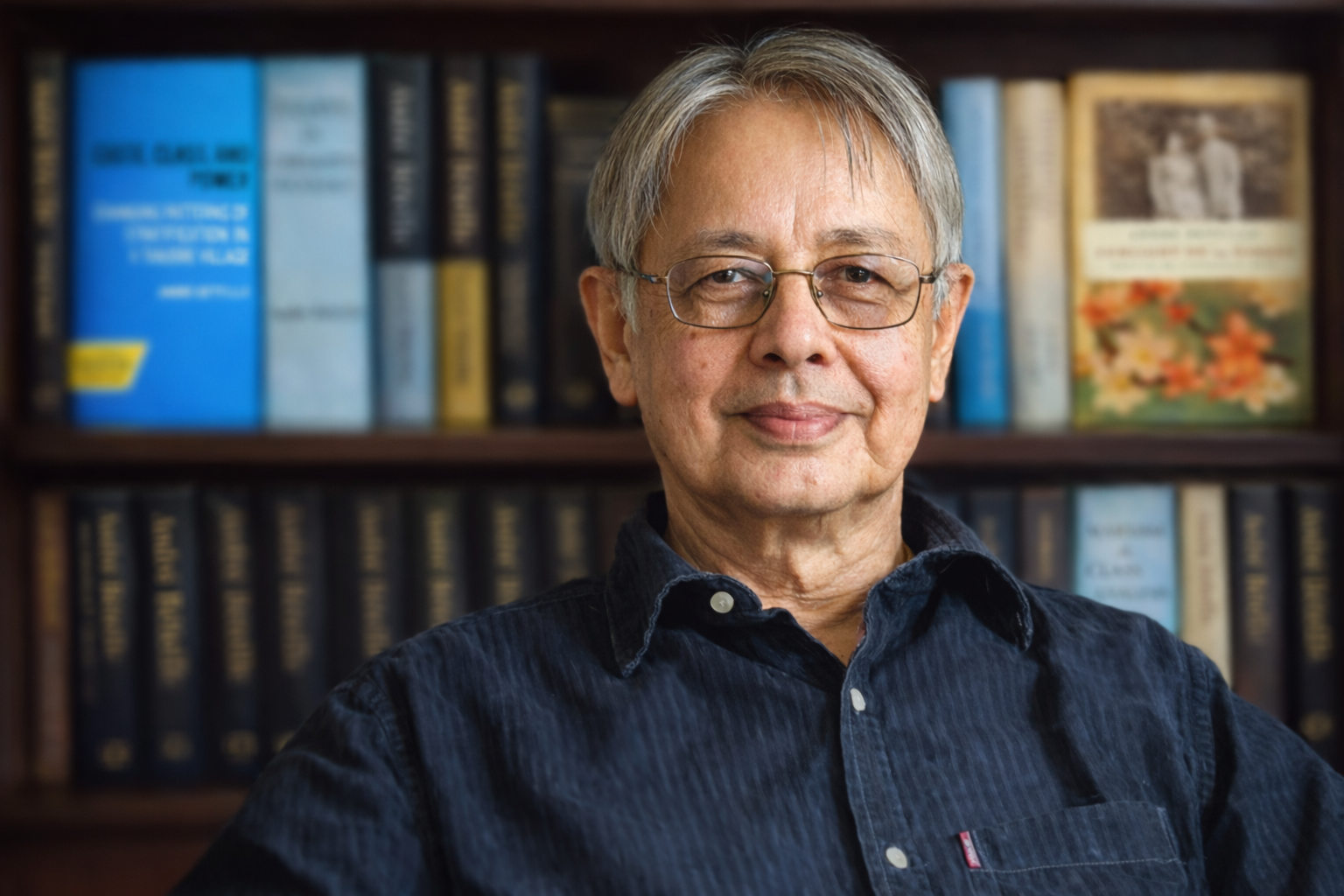
Indian sociology in the 1950s and 1960s was a discipline searching for direction. Much of its language was borrowed from colonial anthropology or from philosophical readings of tradition. Caste appeared in those writings as an ancient design, and Indian society was often described as a museum of customs. André Béteille entered this field with a different temperament. He carried no appetite for grand theories and no desire to defend inherited pictures. Béteille preferred to ask how people actually lived, how they argued with one another, and how institutions altered their chances. His intellectual world was built on observation, comparison, and a steady respect for evidence.
Béteille’s own life introduced him early to more than one horizon. He was born in September 1934 in Chandannagore, then under French administration. His father, a Frenchman who served as mayor of the municipality, and his Bengali mother created a home where European and Indian influences met without ceremony. The young boy listened to Rabindranath Tagore’s songs and read English novels, and he learned that identity could contain several rooms. This background did not turn him into a cultural romantic. It made him cautious about single explanations.
Béteille’s education carried him from Patna to Calcutta and finally to Delhi. At St. Xavier’s College he began with physics, attracted by its discipline and clarity. Halfway through his studies he moved to anthropology under the influence of N.K. Bose, who became his first intellectual guide. Bose taught him that societies reveal themselves slowly and that fieldwork requires humility. After an M.Sc. from Calcutta University and a brief period at the Indian Statistical Institute, Béteille joined the newly formed Department of Sociology at the Delhi School of Economics in the late 1950s. Under M.N. Srinivas he learned the craft of village study and the value of long conversations with ordinary people.
The months he spent in Sripuram village in Tanjore during 1961 and 1962 changed his career. The book that followed, Caste, Class and Power, disturbed the settled vocabulary of Indian sociology. Béteille described a village where status, economic position, and political influence crossed one another in changing patterns. He observed the decline of Brahmin control over land and education, and the gradual rise of non-Brahmin groups through schooling and government employment. The Kala caste seeking recognition as Mudaliyar illustrated how mobility and aspiration altered inherited boundaries. Béteille showed that hierarchy moved with time and opportunity.
This way of seeing brought him into a major debate with Louis Dumont, whose work portrayed caste as a comprehensive moral order based on purity and pollution. Béteille argued that Indian society contained many principles and many disagreements. Drawing on Max Weber, he separated class, status, and power as distinct dimensions of stratification. The disagreement was never personal, but it redirected the discipline from cultural metaphysics to social analysis.
His later writings continued this line of thought. Caste: Old and New examined how modern institutions reshaped traditional forms and how value conflicts replaced the earlier idea of a single consensus. In The Backward Classes and the New Social Order he addressed the politics of reservation. Béteille recognised the need to correct historical wrongs, and he worried that certain policies might freeze identities and encourage electoral arithmetic. He placed greater hope in schools, jobs, and fair procedures than in categorical benefits. His resignation from the Prime Minister’s National Knowledge Commission in 2006, after proposals to expand caste-based reservations, expressed this conviction.
From the 1990s he engaged deeply with questions of justice and liberal philosophy. John Rawls interested him because Rawls spoke of fairness without ignoring institutions. In Equality and Inequality Béteille distinguished between relational inequalities embedded in social ties and distributional inequalities of income and resources. He reminded readers that poverty damages human dignity more directly than ritual labels. He also explored the idea of equality of opportunity, which promised a shift from birth to achievement. The challenge, Béteille wrote, lay in building agencies capable of applying that principle without favour.
Béteille treated sociology as a vocation that required distance from ideological heat. For more than four decades he wrote essays for journals and newspapers, later collected in Ideology and Social Science. These pieces discussed secularism, the middle class, discrimination at work, the changing Indian family, and the responsibilities of intellectuals. He addressed public issues without adopting the tone of daily journalism. He asked sociologists to serve society by explaining it rather than by speaking on its behalf. Béteille avoids fashionable theories and partisan positions, arguing that sociology must be guided by evidence rather than ideology. For him, the sociologist’s task is to analyse social processes, not to serve as an activist spokesperson.
Béteille’s academic career carried him far beyond Delhi. He taught at Oxford, Cambridge, Chicago, the London School of Economics, Berkeley, Rotterdam, and Berlin, and he brought these encounters back into Indian classrooms. He served as Chancellor of North-Eastern Hill University and chaired the Indian Council of Social Science Research. In 1992 the British Academy elected him as Fellow, a rare honour for an Indian sociologist, and in 2005 he received the Padma Bhushan. Later he guided the Centre for Studies in Social Sciences in Kolkata as National Professor. These positions expanded his responsibilities without altering his manner.
Those who knew Béteille remembered a man of wide interests. He could sing Tagore with feeling and discuss Jane Austen with amusement. Among scholars he admired Evans-Pritchard, Max Gluckman, Meyer Fortes, Edmund Leach, and John Barnes, and he drew from them lessons on method rather than doctrine. He respected Marx for his historical imagination but kept Weber close for analytical discipline.
Béteille insisted that sociology begin with the field rather than the library shelf. He asked his students to observe before they judged and to compare before they concluded. He resisted proposals for a separate national sociology and believed that dialogue with other traditions enriched Indian thought. His classrooms at the Delhi School of Economics became places where village data met classical theory without ceremony.
Critics sometimes felt that his confidence in liberal institutions did not capture the intensity of social anger. Béteille listened to such criticism and continued to argue for gradual reform through education, law, and public reason. In an age attracted to quick transformations, his patience appeared modest, but that patience carried its own strength.
The history of Indian sociology over the last sixty years resembles Béteille’s own journey. The discipline moved from reverence for ritual symbols to the study of power and resources, and from fixed descriptions to attention to change. Béteille walked with this movement and often guided it. He left behind a body of work that treated inequality as a human creation open to human effort.
When André Béteille passed away at the age of ninety-one, Indian social science lost a great teacher and scholar, and, of course, a steady companion. The questions he asked about caste, class, equality, and institutions remain. Béteille was with no final answers, but he offered a way of thinking that respected complexity.