
First Published in Eurasia Review, 28 February 2026
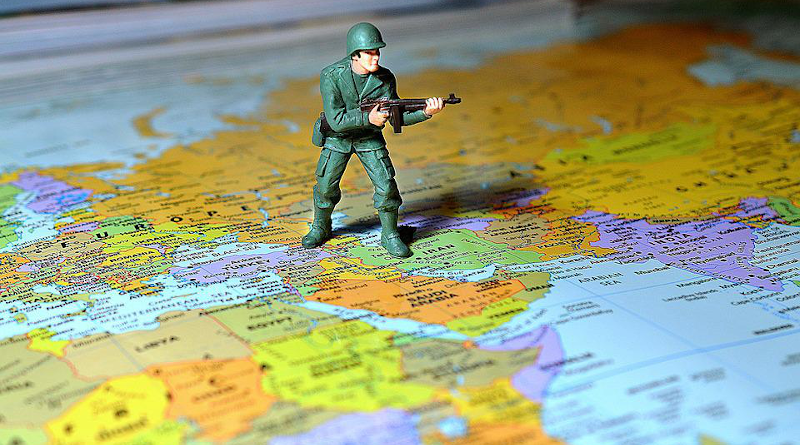
Wars often begin with the claims of necessity. They are justified more often as acts of defence, stability, or prevention. But sometimes the context of a war exposes the deception of the official justifications. The joint U.S.–Israeli strikes on Iran came at a time when both Donald Trump and Benjamin Netanyahu face mounting domestic pressures. Trump has been weakened by judicial setbacks limiting presidential authority, growing political opposition, and the approach of elections. Netanyahu, facing declining public confidence and political fragmentation at home, has long relied on security crises to consolidate support. The present war must, therefore, be seen not only as a strategic action in the Gulf but also as a political move in Washington and Tel Aviv.
The attack has been justified as a response to Iran’s nuclear ambitions and missile programme. But the scale of the strikes and the rhetoric that followed point to a different objective. Statements from both governments suggest that the aim goes beyond restraining Iran’s military capabilities, and thereby to ensure regime change. Calls for the Iranian people to rise against their government, combined with strikes on leadership compounds, indicate that regime change is the prime objective of the operation. The question that immediately follows is palpable: if the regime collapses, who will govern Iran? No credible political alternative has been identified, nor has any transition framework been articulated. History is a record of such misadventures—from Iraq to Libya—of interventions that destroyed states without building replacements.
The legal foundation of the attack is also questionable. Under international law, the use of force requires either self-defence against an imminent threat or authorization from the United Nations Security Council. Neither condition appears to have been met. Claims of long-term hostility or future risk cannot substitute for evidence of immediate danger. The attack therefore sets a dangerous precedent. If preventive war becomes normalised, the prohibition on aggression that underpins the international order risks being hollowed out.
The nuclear question has been central to the narrative used to justify the assault. For years, the United States and Israel have portrayed Iran’s nuclear programme as an existential threat. But the global nuclear history tells a more problematic story. The United States possesses one of the largest nuclear arsenals in the world. Israel, though outside the Nuclear Non-Proliferation Treaty, is widely believed to maintain a substantial but undeclared nuclear stockpile. Several U.S. allies continue to modernise their nuclear forces. Against this backdrop, Iran’s insistence on retaining a civilian nuclear programme—permitted under the treaty it signed—has been treated as illegitimate. This selective enforcement weakens the moral authority of the non-proliferation regime. When rules appear to apply only to adversaries, they cease to function as universal norms.
The collapse of the 2015 nuclear agreement was a turning point. That accord had significantly limited Iran’s enrichment capacity and allowed extensive international monitoring. The U.S. withdrawal in 2018 undermined the framework of trust that sustained it. Since then, negotiations have been marred by mutual suspicion and changing demands. Recent talks offered a narrow opportunity for renewed engagement, but they unfolded under the shadow of a massive military build-up. Diplomacy conducted alongside preparations for war rarely produces compromise. The outcome was predictable – mistrust intensified, and military logic prevailed.
The consequences of this war may extend far beyond Iran. The Persian Gulf is one of the most strategically sensitive regions in the world, and its stability is closely tied to global energy flows. The Strait of Hormuz, through which roughly one-fifth of the world’s oil supply passes, is particularly vulnerable. Any disruption to shipping through this narrow passage would impact the global markets. Oil prices could surge dramatically, affecting economies from Asia to Europe. Even limited interference could create panic in energy markets and strain economic recoveries worldwide.
The Gulf is also heavily militarised. Tens of thousands of U.S. troops are stationed across bases in Qatar, Bahrain, Kuwait, the United Arab Emirates, and elsewhere. These installations, intended as deterrents, are also potential targets. Iran’s missile capabilities and network of regional allies mean that retaliation could spread rapidly. Already, signs of a multi-front confrontation are emerging, with threats to shipping, regional bases, and allied infrastructure. What begins as a targeted campaign could easily escalate into a larger regional war.
Regional powers face difficult choices. Some Gulf states fear Iranian influence and support pressure on Tehran. But they also depend on regional stability and uninterrupted trade. A prolonged conflict would threaten their economic models and internal security. Turkey, Saudi Arabia, and others may respond by expanding their own military capabilities, potentially accelerating a regional arms race. The war may cause not only immediate destruction but also a long-term spiral of militarisation.
Global reactions so far have been cautious and largely rhetorical. European leaders have expressed concern and urged restraint. Some states have emphasised the need to prevent Iran from acquiring nuclear weapons while avoiding direct condemnation of the strikes themselves. Major powers such as Russia and China have positioned themselves as observers or potential mediators. This shows a conventional pattern: strong words, limited action. However, such passivity may encourage further unilateral interventions in the future.
The domestic dimension within the United States also deserves attention. Critics in Congress have argued that the attack was launched without proper authorization, raising constitutional questions about the limits of presidential war powers. The tension between executive decision-making and legislative oversight has long impacted American foreign policy, but it becomes more acute when military action involves large-scale escalation. If Congress remains sidelined, the precedent may strengthen executive authority in future conflicts as well.
The likely course of the war remains uncertain. Militarily, the United States and Israel possess overwhelming air power and technological superiority. They can inflict significant damage on Iranian infrastructure. Nonetheless, Iran retains substantial capacity for asymmetric response. Its missile arsenal, naval capabilities in the Gulf, and network of regional partners give it tools to prolong the conflict. A short war is possible, but a contained war is far less certain. Even limited strikes could provoke cycles of retaliation that may extend for months or years. Nobody can predict it now given the experience of other wars in recent years.
Military campaigns aimed at weakening regimes may strengthen them instead. External pressure can rally domestic support around governments that might otherwise face internal dissent. If Iran’s leadership portrays the war as a defence of national sovereignty, the effect may be to consolidate rather than undermine its authority. In that sense, the strategy of coercive regime change may produce the opposite of its intended outcome.
The implications for the international system are far-reaching. The weakening of diplomatic norms, the selective application of non-proliferation rules, and the growing acceptance of preventive war all point toward a more unstable global order. If major powers act outside established legal frameworks, smaller states may conclude that treaties and institutions offer little protection. The result could be a world where security depends increasingly on military strength rather than negotiated rules.
The war in the Gulf is, therefore, a confrontation with global implications. If there is still room for diplomacy, it must be retrieved without delay. Otherwise, the conflict may become one more distressing episode in a pattern of interventions that promise stability but deliver prolonged instability.

Leave A Comment